

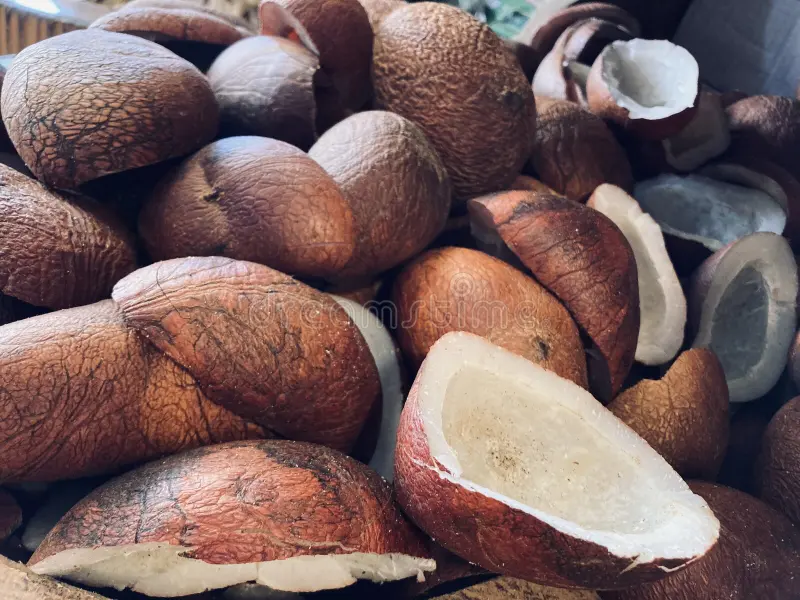
Since we’ve been talking about 250g of the stuff, let’s look at what actually makes up a coconut. It’s one of the most versatile ingredients on the planet—every part of it can be eaten, drunk, or turned into a bowl.
Technically, a coconut is a fibrous one-seeded drupe (a fruit with a hard stony covering, like a peach), though we treat it as a fruit, a nut, and a seed all at once.
🥥 The Physical Anatomy
If you were looking at a whole coconut, here is the breakdown from the outside in:
-
Exocarp & Mesocarp (The Husk): The green or brown outer skin and the thick, stringy hair. Usually removed before it hits your grocery store.
-
Endocarp (The Shell): The “nut” part—that hard, woody brown layer you have to whack with a hammer.
-
Endosperm (The Meat): This is the white, fleshy part we eat.
-
Young/Green: Soft, jelly-like, and sweet.
-
Mature/Brown: Firm, crunchy, and rich in fats.
-
-
Liquid (The Water): The clear, refreshing juice found in the center (not to be confused with coconut milk, which is processed from the meat).
👅 Flavor & Texture Profile
-
Taste: Mildly sweet with a distinct “nutty” undertone. It has a high fat content, giving it a rich, creamy mouthfeel.
-
Aroma: Highly aromatic (thanks to molecules called lactones). This is the “tropical vacation” smell.
-
Texture: Varies from creamy (milk/cream) to chewy (shredded) to crunchy (toasted flakes).
🧬 Culinary Roles
Coconut acts as a “chameleon” in the kitchen:
-
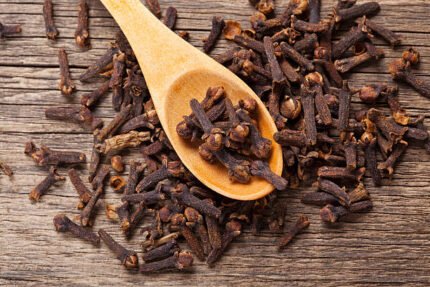
The Cooler: It balances out high heat in spicy curries (like those using your Cloves).
-
The Binder: Desiccated coconut (250g) provides structure in gluten-free baking.
-
The Fat Source: Coconut oil is a stable fat for high-heat frying or as a vegan butter replacement.
Reviews
There are no reviews yet.